
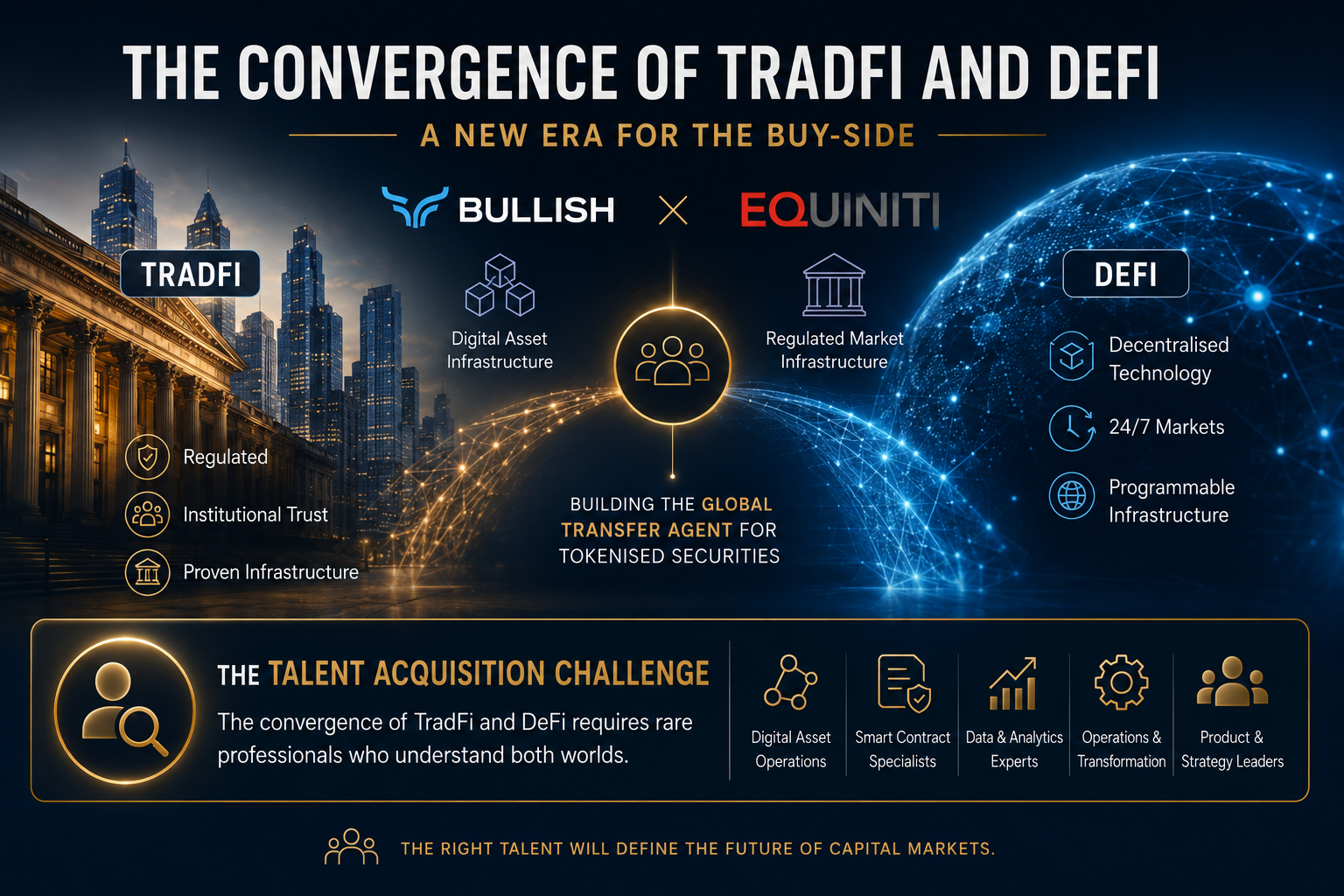
For years, decentralised finance (DeFi) and traditional finance (TradFi) were positioned as competing models—one built around regulated intermediaries, established market infrastructure, and legacy operating models; the other around blockchain networks, smart contracts, tokenisation, and 24/7 programmable markets.
Today, that divide is disappearing.
The buy-side is entering a new phase where traditional financial infrastructure and blockchain-native operating models are beginning to converge. Several recent transactions illustrate that crypto companies are not simply buying scale they are redesigning the infrastructure of capital markets and with this the talent requirements needed to build, operate, and scale it.
The Buy-Side Operating Model Is Changing
As TradFi and DeFi converge, investment managers are beginning to rethink how funds are issued, distributed, serviced, settled, and reported.
We are moving toward a world where:
- Fund units are issued directly to whitelisted digital wallets
- Investor eligibility is enforced via smart contracts
- Transfer agency becomes programmable
- Corporate actions can be automated
- Private market assets gain controlled secondary liquidity
- Settlement increasingly moves toward real-time
In other words, firms are no longer just tokenising products.
They are tokenising operations.
The Real Constraint Is No Longer Technology—It’s Talent
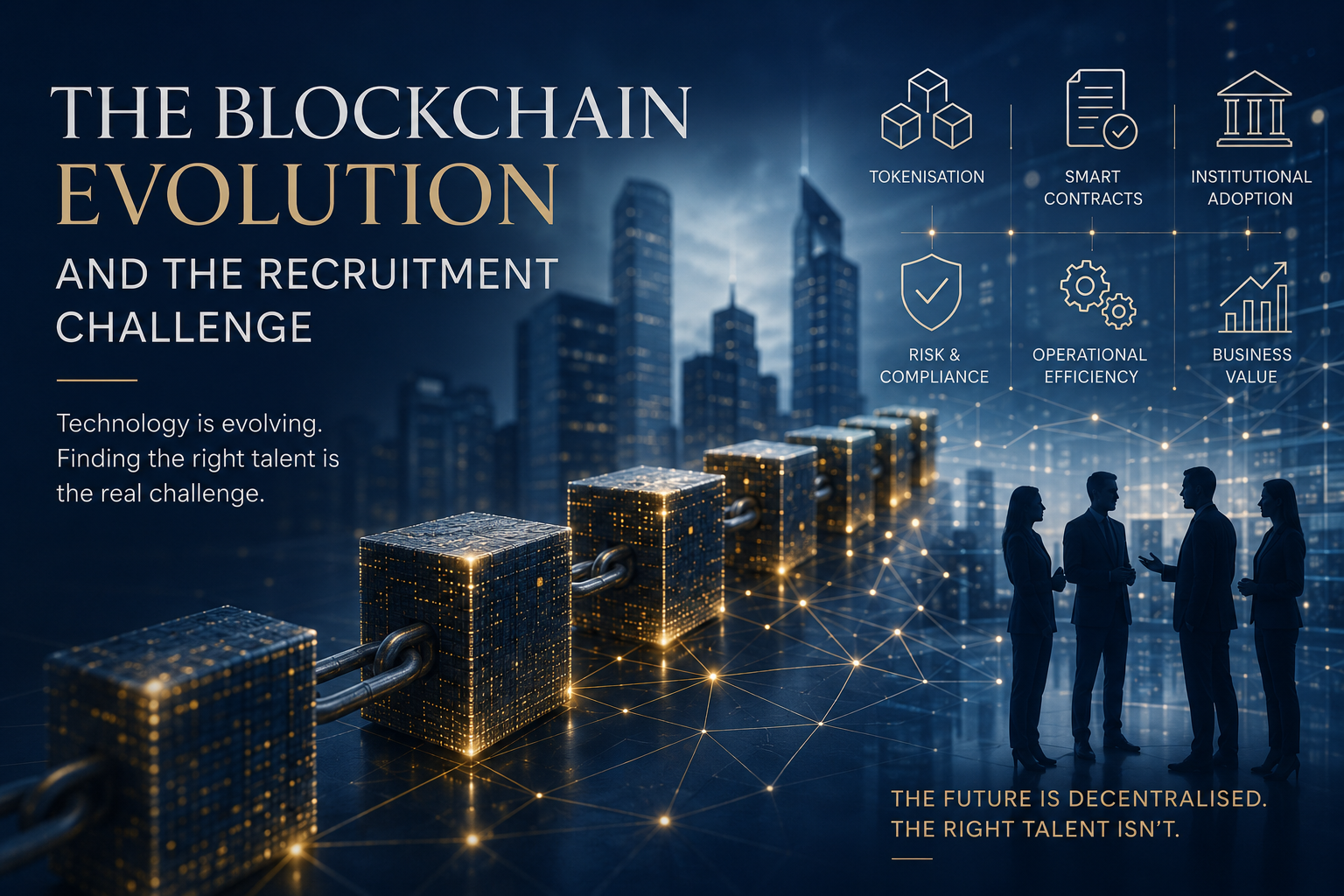
While the technology is maturing rapidly, the biggest challenge many firms now face is talent acquisition.
Traditional teams built around fund operations, transfer agency, custody, product management, investor servicing, and oversight are now being asked to operate alongside blockchain developers, digital asset specialists, automation engineers, and data-led transformation teams.
Very few professionals today genuinely understand both worlds.
A transfer agency expert may understand shareholder records, NAV oversight, and regulatory controls—but not wallet whitelisting, token standards, or smart contract workflows.
A blockchain engineer may understand tokenisation and on-chain settlement—but not fund accounting, investor servicing, or operational resilience in institutional markets.
That intersection is where the real skills shortage exists.
Talent Acquisition Is Becoming Strategic Infrastructure
Demand for a new generation of talent across:
- Digital Asset Operations
- Smart Contract Operations
- Blockchain Settlement
- Tokenisation Product Management
- AI and Workflow Automation
- Digital Risk and Controls
- Data and Operational Analytics
At the same time, traditional leadership roles such as COO, Head of Operations, Fund Operations, Product, and Oversight are evolving to require a far broader digital skillset.
For buy-side firms, recruitment is no longer simply about replacing existing roles.
It is about building hybrid teams capable of bridging institutional finance and next-generation market infrastructure.
We are already seeing this shift first-hand—clients increasingly looking for professionals who can combine deep operational credibility with digital fluency, regulatory understanding, and the ability to lead transformation in highly complex environments essentially those that know how to make both these worlds work together.
.jpg)
.jpg)
.jpg)
.jpg)

.jpg)