
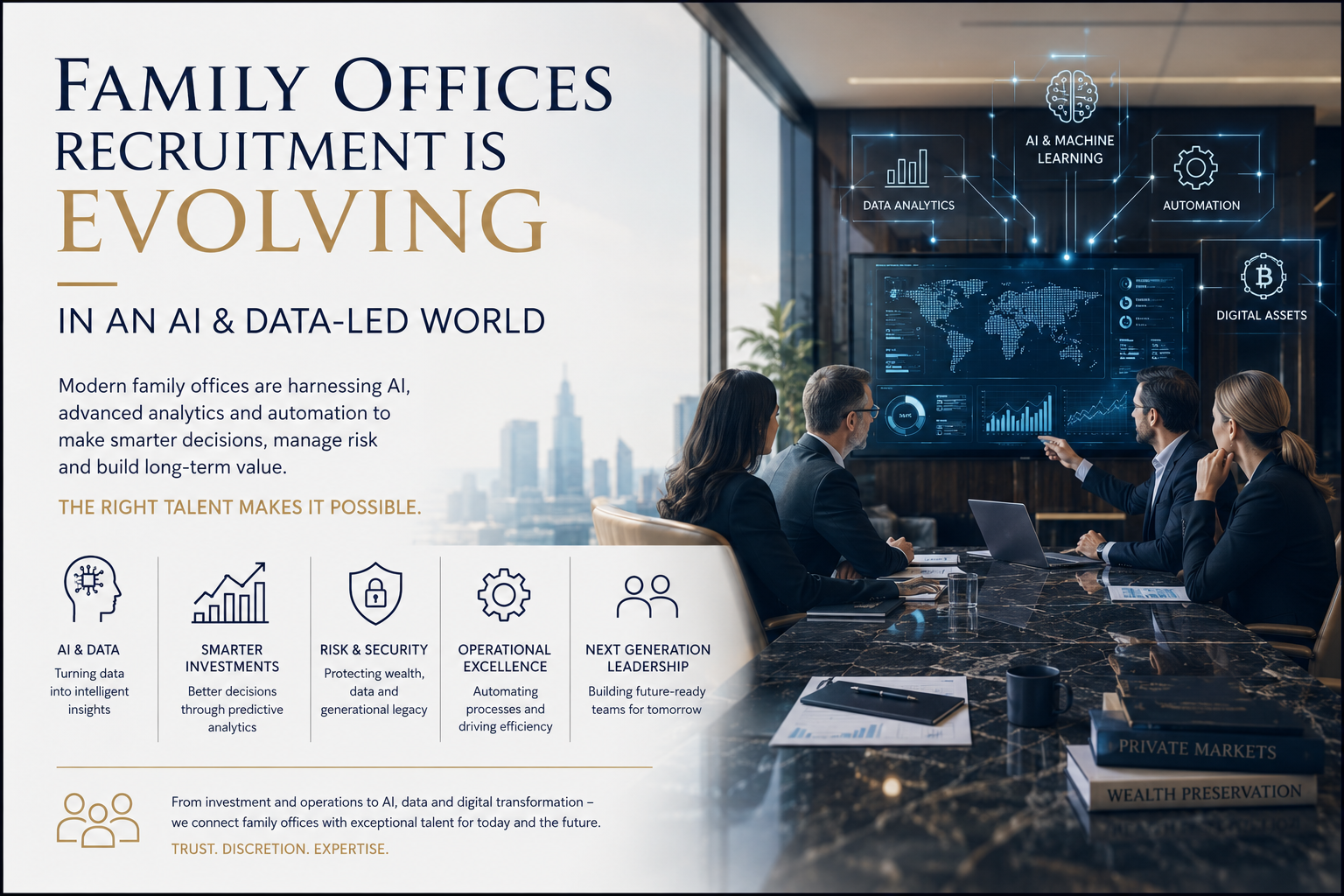
For decades, family offices have built their success around trust, discretion, long-term relationships, and highly personalised investment management. Recruitment within the sector traditionally reflected these priorities—focusing on experienced investment professionals, accountants, tax specialists, private assistants, and operational leaders with deep networks and impeccable judgement.
Those fundamentals remain.
But the modern family office is changing rapidly, and so are its talent requirements.
As artificial intelligence, advanced analytics, digital assets, automation, and real-time data become increasingly embedded in wealth management, today’s family offices are no longer simply managing capital—they are becoming sophisticated data-driven enterprises.
And that evolution is reshaping recruitment in ways many firms are only beginning to appreciate.
From Relationship-Driven to Intelligence-Driven
Historically, competitive advantage in a family office often came from access—access to managers, deals, advisers, and networks.
Today, access alone is no longer enough.
The most forward-thinking family offices are now asking:
- How can AI improve investment research?
- How can portfolio risk be monitored in real time?
- How can private market data be consolidated across multiple custodians and managers?
- How can operational processes be automated without losing control?
- How can next-generation beneficiaries access information digitally and instantly?
These are no longer technology questions.
They are talent questions.
The New Roles Emerging
Alongside traditional investment and finance hires, family offices are increasingly looking for professionals who can bridge wealth management with digital innovation.
Demand is growing for:
- AI and data analysts who can turn fragmented portfolio data into actionable insight
- Investment technology specialists who can integrate reporting, analytics, and automation platforms
- Digital operations professionals who can streamline onboarding, reporting, compliance, and treasury workflows
- Cybersecurity and digital risk specialists who can protect highly sensitive financial and personal data
- Digital asset and blockchain specialists as alternative asset strategies evolve
- Chief operating and transformation leaders who can modernise legacy operating models
These roles often sit somewhere between investment, operations, and technology—making them particularly difficult to define, benchmark, and hire.
The Recruitment Challenge
Unlike large institutions, most family offices do not have large internal talent acquisition teams or clearly defined digital career paths.
Many are hiring these capabilities for the first time.
That creates several challenges:
1. The role itself may not yet exist
Often the brief starts with a business problem, not a job title.
"We need better reporting."
"We need AI to help our investment team."
"We need a single view across all managers and portfolios."
Turning those objectives into a hire requires deep market understanding.
2. The best candidates rarely come from family offices
Many of the strongest candidates currently sit within:
- Asset managers
- Investment platforms
- Fintechs
- Private banks
- Data providers
- Digital asset businesses
- Technology consultancies
Attracting them into a family office environment requires a very different value proposition.
3. Cultural fit matters more than ever
Technical expertise alone is not enough.
Family offices still operate on trust, confidentiality, agility, and close stakeholder relationships. Candidates must combine digital capability with emotional intelligence, commercial judgement, and discretion.
That combination is rare.
The Next Generation Is Driving Change
A major catalyst behind this shift is generational transition.
As younger family members become more involved in governance and investment decisions, expectations are changing.
They expect:
- Real-time portfolio visibility
- Mobile-first reporting
- Data-driven decision making
- Exposure to emerging technologies
- Alternative investments, digital assets, and venture opportunities
- More efficient, scalable operating models
This is pushing family offices to recruit talent that can modernise without disrupting the personalised service model that defines the sector.
Recruitment Is Becoming More Strategic
In this new environment, recruitment is no longer about replacing a finance director or hiring another investment analyst.
It is about building future capability.
The family offices that will outperform over the next decade are unlikely to be those with simply the largest balance sheets.
They will be the ones that successfully combine traditional stewardship with modern intelligence—bringing together investment expertise, operational excellence, and digital innovation.
And that starts with hiring the right people.
At Mayford, we are seeing first-hand how family office recruitment is evolving—from traditional operational hires to specialist talent across AI, data, digital transformation, and next-generation investment infrastructure.
Because in a world increasingly shaped by technology, the most valuable asset remains the right talent.
.jpg)
.jpg)

.jpg)
.jpg)